Weaponising Landscape:
Spatial Tactics and Moral Alibis at the Franco-British Border
This study delves into the transformations happening in Calais, a port city in Northwestern France. These transformations are a result of the years-long struggle against “illegal” migration, both French and British authorities are fighting using natural environments as a “moral alibi”, it argues that nature is weaponised to mask political border enforcement as environmental management and, by externalising resources like infrastructure, capital and surveillance technology outside the UK border in the process of “securing” the UK-FR border.

Medium
Interactive map, photography, writing
Role
Research, mapping, fieldwork, writing, photographic documentation, ethnographic studies
Credits
Riccardo Badano, Helen Brewer
Institution
Royal College of Art London
Placed above is an interactive spatio-temporal map that explores the transformation of green spaces along the Franco-British border and the events that led them.
Keywords: UK-FR Border, Externalised border, Displacement crisis, Border-making practices, Racialising nature, Calais, Grand-Synthe, Deforestation, Herbal Medicine, Invisibility
Summary
"Weaponising Landscape: Spatial Tactics and Moral Alibis at the Franco-British Border" delves into the transformations happening in Calais and Grand-Synthe, two port cities in Northwestern France. These transformations result from a year-long struggle against "illegal" migration, which both French and British authorities fight using natural environments as a "moral alibi" and by externalising resources—such as infrastructure, capital, and surveillance technology—outside the UK border in the process of "securing" the UK-FR border.
Within this research, externalisation carries a two-fold meaning:
-
Extraterritorial Infrastructure: How the UK border operates through an assemblage of border technologies, legal infrastructures, and logistical arrangements beyond the UK’s territory.
-
Weaponising Nature: How the "natural" environment is mobilised and instrumentalised into border-making practice to externalise the politics of displacement outside the realm of the "political".
Key Findings &
Research Themes
1. Externalising via Capital and Technology
Since 2015, the British government has paid at least £300 million to French authorities to stop asylum seekers originating from France. Through bilateral agreements (e.g. Joint Declarations, the Sandhurst Treaty, and Joint Action Plans), millions have been spent to militarise coastal cities in Northwestern France.
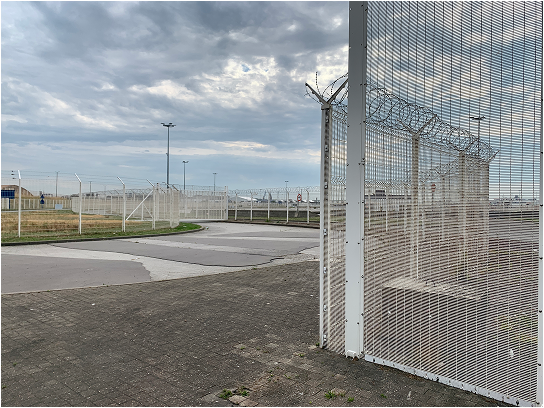
A primary example is Fort Vert Natural Reserve: the site of the former "Calais Jungle" (La Lande), which once housed at least 6,000 people, was razed in 2016 and converted into a fenced natural reserve with warning signs, alarms, and dogs to prevent migrant encampments from returning.


2. Forced Evictions & Anti-Fixation Strategies
French authorities enforce an "anti-fixation" strategy to deter gathers or encampments. Measures include:
-
Vegetal Razing: Clearing wooded areas and bushes to destroy natural cover.
-
Hostile Landscaping: Placing large boulders spaced less than 1.5 metres apart to prevent tents from being pitched.
-
"Scorched Earth": Purchasing and destroying land used by migrants to prevent informal settlement.


3. Nature as a "Moral Alibi"
Authorities use psychological rationalisation and "greenwashing" to mask displacement efforts. Sites like ZI Les Dunes(where trees were cut and immediately replanted behind fences) and Bois Chico Mendes (reclassified into a €1.5M urban park) show how environmental concerns, storm safety, or waste cleanup are used as moral alibis to depoliticise forced evictions.


4. The Paradox of Invisibility
Displaced populations rely on woods as an "invisibility cloak" for protection against ground and aerial surveillance. When state forces destroy brush while leaving tall trees, or clear living sites completely, they deliberately make people visible and vulnerable to show public action while attempting to invisibilise the crisis itself.


Counter-Infrastructures & Grassroots Agency
In response to state hostility, grassroots organizations navigate legal and spatial grey zones to construct networks of solidarity:
-
Mobile Herbal Clinic: Leverages legal asymmetries between British and French laws regarding herbal medicine. Operating in a legal "grey zone", volunteers harvest plants in the UK and transport handmade remedies to people in transit in Calais and Dunkerque without interference from border officials.
-
Calais Woodyard: Addresses basic winter survival needs by purchasing sawmill waste wood to distribute directly to living sites, restoring a degree of autonomy to displaced communities.
Actionable Framework: Spatial Agency
To move from passive critique to active spatial justice, this research proposes three action pillars:
1. Tactical Counter-Infrastructures: Designing rapid-deploy, mobile distribution units and micro-shelter strategies that operate outside static "points of fixation".
2. Spatial Forensics & Legal Advocacy: Using counter-mapping and timeline visualizations as forensic evidence in administrative courts to challenge illegal evictions and municipal greenwashing.
3. Subverting Legal & Material Grey Zones: Mapping regulatory gaps to establish solidarity corridors and creating circular material networks that intercept cleared timber for community heating.